

Are you perfecting a business model that is losing value?
A topic on many leadership agendas is how fast the company should adopt AI. However, the bigger risk is a business model that has worked so well that nobody questions it any more. Its logic of success may rest on conditions that no longer hold, and the way the organisation is built makes this easy to miss. AI makes that more pressing: it shortens the window in which leaders can spot the shift and adapt the business model before the figures turn.
How success turns into blind spots
Every successful company runs on a logic of success of its own: a set of beliefs about what customers pay for and where the company has the edge. Few companies write these down. They grow out of experience, and for years they prove correct.
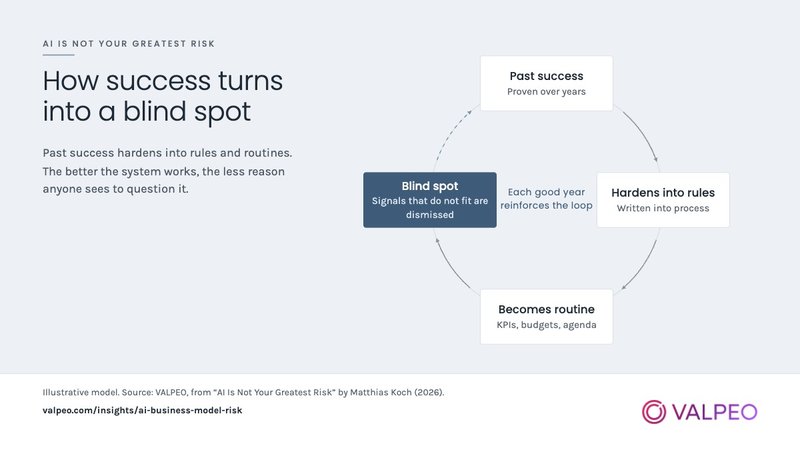
Gradually, past successes harden into rules, and the rules become routines. In time, the company organises its KPIs, the budget process, the incentives and even the agenda of the leadership meeting around those routines. This makes sense: no company can rethink everything every day. The cost is less visible: the organisation becomes highly skilled at measuring and refining the current business, and far less adept at noticing when the business itself needs to change. As a result, the better the system works, the less anyone questions it.
Why the first signs of change rarely look urgent
Signs of change do appear, though seldom in a form that demands attention: a lost tender here, a new competitor there. Meanwhile, customers keep buying and margins hold in the early stages. Such signals are easily overlooked for a structural reason: a company’s dashboards measure the business it already has. They show how well today’s model is performing, but say little about whether tomorrow’s customers will still want that model. A shift therefore tends to reach the figures late, by which time competitors have often already made their move.
Companies rarely fail because they suddenly become incapable of making good decisions. More often, they continue making yesterday’s good decisions after the conditions that made them good have begun to disappear. German industry shows how this plays out. For decades its model rested on engineering excellence, exports, affordable energy and long-standing customer relationships. Within a few years, several of those conditions shifted: the economy grew by just 0.2% in 2025 after two years of contraction, German companies pay some of the highest gas prices in the EU, labour costs sit 29% above the EU average and manufacturing shed around 144,000 jobs in the year to mid-2026.
Consider a scenario many Mittelstand leaders will recognise: a third-generation, family-owned machine builder with world-class engineering and loyal customers. Its logic of success has served it well: “Customers buy precision, and our know-how takes decades to copy.” Now a younger competitor sells “good enough” machines with AI-based remote diagnostics and charges for guaranteed uptime. Customers’ procurement teams begin to weigh total cost alongside tolerances. The quarterly figures still look healthy, so the shift has not yet reached the leadership agenda. Nobody has yet asked whether customers still buy precision.
Within two years, a long-standing customer moves part of its next order to the challenger. The logical response is to offer a discount, which protects volume but erodes margin. All the while, the challenger’s connected machines send back data from every site they run on, so its service improves with each installation.
“Questioning the business model early costs far less than catching up once the figures turn.”
How AI raises business model risk
With AI, three conditions that many business models take for granted are changing:
- Expertise gets cheaper. Knowledge that used to come from a handful of experts becomes available to many people, inside and outside your company.
- Capabilities spread faster. Competitors can now test in months what used to take years to build.
- Size matters less. Smaller players can access capabilities that used to require a large organisation.
If your advantage depends on scarce expertise, long build times or scale, this is where AI business model risk is highest: competitors using AI will aim squarely at that advantage.
Some 58% of Mittelstand firms already use AI. At the same time, 41% of the firms surveyed cannot yet see a clear economic benefit, and only 16% plan significant investment. Spending, too, remains modest: German manufacturers invest 0.6% of revenue in AI, against 2.9% in the US, and the most advanced uses sit in operations and administration.
The decisive choice is which of two questions should steer the company’s AI effort:
- “Where can AI make what we already do more efficient?”
- “If we built this business today, knowing what AI can do, would we build it the same way?”
The first question brings quick wins and lower costs with little disruption, but risks perfecting a model that is losing value. The second demands investment and a tolerance for uncertainty, and may cost part of today’s revenue, but builds a position that will still hold in five years.
In practice, most companies need to do both: improve today’s model and test tomorrow’s. The risk lies in drifting towards efficiency by default, without ever deciding how to divide the effort between the two.
Why leadership teams keep defending a model that is losing value
The years in which the current model succeeded shape a leadership team’s thinking. The leadership of an engineering firm, for instance, knows how to win on precision and which customers value it most. That knowledge remains valuable, but it describes today's model. The team reads every new signal through it, so a lasting loss of value tends to look like a temporary dip. Capable teams fall into this trap without any shortage of intelligence or information. What holds them back is the way the organisation is built. Four patterns recur.
1. They measure what made them successful. Strategy discussions run on data from the current business. Signals that do not fit the existing model never make it onto the agenda.
2. The organisation rewards defending the core. Budgets, targets and bonuses are tied to today’s business. A division head who argues that their own product line is losing relevance puts their own position at stake.
3. Agreement is mistaken for alignment. Everyone agrees on the direction, but nobody has tested it against changed conditions. In founder-led and family-owned companies, questioning the business model can feel like questioning the people who built it. When this coincides with a generational handover, as it does in many Mittelstand firms, the conversation grows more delicate still. As a result, disagreement starts to feel like disloyalty, and people keep their doubts to themselves.
4. The people question is left until last. Many leadership teams treat the impact on jobs as something to communicate once they have made the decisions. However, employees and works councils will assess AI by what it means for their roles, and in Germany they have a formal say: since 2021, the Works Constitution Act has required employers to inform the works council in good time about plans to use AI in work processes, and allows the council to call in an external expert to assess it. A leadership team that has not decided which roles will change, and which will stay, has no credible answer to give, and without one adoption stalls. The current model then survives by default.
Because each of these patterns is built into the way the organisation works, each can also be redesigned.
How strong leadership teams break the pattern
The teams that handle this well keep questioning their logic of success while it still works.
They look beyond their own figures. Alongside the financial KPIs, they track why customers leave and which tenders they lose. They also write down the few beliefs their logic of success depends on, and review them as regularly as the financial forecast.
They fund the next model separately. A ring-fenced budget for small, time-limited experiments means that testing tomorrow’s model never has to compete with today’s targets, and nobody has to stake their position on proposing one.
They make challenge part of the job. They assign one member to argue the opposing case and rotate the role, so challenge never rests with the same person. The team then tests its assumptions before it commits.
They involve HR early. They involve the head of HR while the options are still open. The consequences for roles then shape the plan from the start, so the leadership team can tell employees and the works council where they stand before speculation takes hold.
The greatest risk for a company is a leadership team that keeps running a successful model after the conditions behind it have shifted, reassured by figures that only describe the past. AI makes that risk more costly, because competitors can now test new models in months and erode advantages that took decades to build. The leadership task itself stays the same: making sure decisions keep pace with the change around the business
The companies that do well in the coming years will be those whose leaders keep asking why customers choose them, and whether that answer still holds. They act while the figures look healthy, and they can still choose when and how to change course.
That is where VALPEO works with leadership teams: helping them test which parts of their logic of success still hold, and align leadership and decision-making with what comes next.